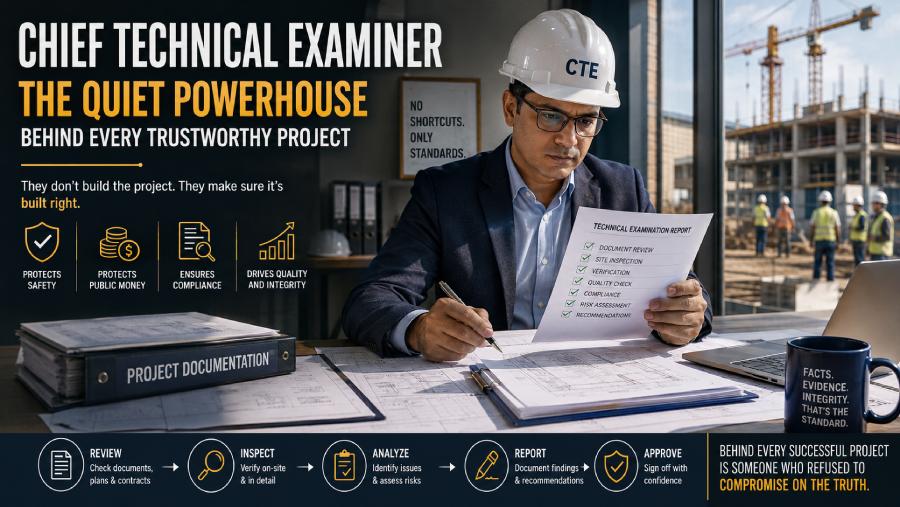
Let’s be honest about something most people never think about. When a bridge stays standing, when a software system passes a critical audit, when a government project actually delivers what taxpayers paid for, there’s usually someone in the background who made sure of it. That person is often a Chief Technical Examiner. It isn’t a flashy job, and you won’t see it trending on social media, but it’s one of those roles that quietly holds entire industries together. The Chief Technical Examiner, or CTE for short, is the senior expert who checks, verifies, and signs off on technical work before anyone else can confidently say “yes, this is done right.” In a world where projects keep getting bigger, budgets keep getting tighter, and the consequences of failure keep getting scarier, this role has become more important than ever.
What Exactly Is a Chief Technical Examiner?
A Chief Technical Examiner is a senior technical authority whose main job is to review and validate work that other people have built or designed. Notice the key word there: review. A CTE doesn’t usually pour the concrete, write the code, or assemble the machinery themselves. Instead, they look at what’s been produced and ask the hard questions. Does this meet the approved standards? Was it built the way the contract said it would be? Are the materials right? Are the numbers honest? Think of them as a combination of a referee, an auditor, and a seasoned engineer rolled into one. They sit at the top of the technical food chain in their organization, which means their opinion often carries the final word. When a CTE puts their signature on something, they’re essentially staking their professional reputation on the claim that the work is sound, compliant, and safe.
Where Do Chief Technical Examiners Actually Work?
You’ll find Chief Technical Examiners scattered across a surprising number of industries, and that’s because almost every field that produces something complex needs someone to check that complex thing. They’re common in government departments and public works agencies, where they audit infrastructure projects, roads, buildings, and public spending. They show up in engineering and manufacturing firms, in construction, in aerospace and defense, and increasingly in technology-heavy spaces like software development, cybersecurity, and financial technology. The common thread is regulation and risk. The more tightly an industry is regulated, and the bigger the consequences of getting something wrong, the more likely it is to have a dedicated CTE or an entire technical examination wing led by one. In many public-sector setups, particularly in countries like Pakistan and India, the Chief Technical Examiner is a formally defined government post tied to anti-corruption and procurement oversight, which is a slightly different flavor of the same core idea.
The Core Responsibilities of the Role
So what does a Chief Technical Examiner actually do all day? At the heart of it, they review designs, drawings, and technical documentation to confirm everything lines up with approved specifications. They inspect ongoing work to catch problems while they can still be fixed cheaply, rather than after everything is sealed up and finished. They scrutinize procurement processes, including tenders, bids, and contract awards, to make sure nobody is inflating costs or playing favorites. And they produce detailed reports that translate technical findings into language decision-makers can actually use. These reports often deal with uncomfortable subjects like cost overruns, quality shortcuts, and contract violations, which is why a good CTE needs a thick skin alongside a sharp mind. The job is part detective, part teacher, and part referee, and it rarely involves saying only the things people want to hear.
Why the Chief Technical Examiner Matters So Much
Here’s the thing nobody likes to admit: most big project failures don’t come from one giant, obvious blunder. They come from a hundred small mistakes that everyone ignored. A skipped inspection here, a sloppy record there, a quality check that got rushed because the deadline was looming. Individually, none of those feel like a big deal. Stacked together over months, they become the reason a building cracks, a system gets breached, or a budget doubles. The Chief Technical Examiner exists precisely to catch those small things before they pile up into a disaster. By insisting on proper documentation, demanding real evidence instead of verbal assurances, and refusing to wave things through just to keep people happy, the CTE protects public money, protects safety, and protects the long-term integrity of whatever is being built. In a very real sense, they’re an insurance policy that thinks for itself.
The Skills That Separate a Good CTE From a Great One
Becoming a Chief Technical Examiner takes more than just being a strong engineer, although that’s certainly the foundation. The role demands deep technical knowledge, because you can’t catch a mistake you don’t understand. But raw expertise alone isn’t enough. A great CTE pairs that knowledge with sharp analytical thinking, the kind that spots a discrepancy buried in a forty-page report or notices that two sets of numbers don’t quite add up. They need investigative instincts, almost like an auditor or an inspector, because plenty of problems are hidden rather than obvious. And critically, they need communication skills, because being right means nothing if you can’t explain it clearly to a project manager, a finance director, or a politician who has never read a technical drawing in their life. The ability to translate complexity into clarity is genuinely one of the most valuable things a CTE brings to the table.
A Day in the Life of a Chief Technical Examiner
No two days look exactly alike, which is part of what makes the role interesting. One morning might be spent in the office, poring over project files, comparing as-built drawings against the original approved plans, and flagging anything that doesn’t match. The afternoon might involve a site visit, where the examiner walks through an active construction zone or inspects installed equipment to verify it matches the paperwork. Another day could be dominated by writing, as the CTE drafts a formal examination report that will eventually land on a senior executive’s desk. There are meetings, too, often tense ones, where findings get presented and contractors or internal teams push back. Through all of it, the examiner has to stay objective and evidence-driven, resisting the pressure to soften conclusions just because the news is unwelcome. It’s a job that rewards patience, attention to detail, and a stubborn commitment to the facts.
How a Technical Examination Actually Works
A technical examination usually follows a logical flow, even if the specifics vary by industry. It typically starts with document review, where the examiner gathers everything relevant: contracts, specifications, design approvals, change orders, and financial records. From there, they move into verification, comparing what was promised against what was actually delivered. This often means physical inspection, sampling, or testing, depending on what’s being examined. As the picture becomes clearer, the examiner identifies gaps, irregularities, or risks and documents each one with supporting evidence. Finally, they compile their findings into a structured report, complete with conclusions and recommendations. The recommendations matter just as much as the criticisms, because a good examination doesn’t just point out what went wrong; it shows how to fix it and how to stop it from happening again. That forward-looking element is what turns a CTE from a fault-finder into a genuine improvement engine.
The CTE in the Public Sector Versus the Private Sector
While the fundamental job stays the same, the texture of the role shifts depending on whether you’re in government or private industry. In the public sector, the Chief Technical Examiner often functions as a guardian of public funds and a check against corruption. Their examinations of tenders and contracts are designed to keep the spending of taxpayer money transparent and fair, and their reports can have real political and legal weight. In the private sector, the emphasis usually tilts toward quality assurance, regulatory compliance, and protecting the company from liability and reputational damage. A private-sector CTE in aerospace or medical devices, for example, might serve as the final technical approval before a product can ship, knowing full well that a missed defect could cost lives and lawsuits. Both versions of the role share the same DNA, but the stakes and the surrounding pressures are flavored differently.
Common Challenges Chief Technical Examiners Face
This is not an easy job, and pretending otherwise would do it a disservice. One of the biggest challenges is pressure, plain and simple. Examiners regularly face people who want their project approved quickly and aren’t thrilled about an outsider poking holes in it. Standing firm against that pressure, especially when powerful stakeholders are pushing back, takes real backbone. Another challenge is keeping up with constant change, because standards, regulations, and technologies evolve faster than ever, and an examiner who stops learning quickly becomes ineffective. There’s also the sheer volume and complexity of modern projects, which can overwhelm even experienced professionals if they don’t have good systems and a sharp team behind them. And finally, there’s the emotional weight of delivering bad news, of being the person who has to say “this isn’t acceptable” when everyone else just wants to move on. It’s a role that quietly tests character as much as competence.
How to Become a Chief Technical Examiner
If this role appeals to you, the path usually starts with a solid technical education, often a degree in engineering, computer science, or a closely related field, followed by years of hands-on experience in design, construction, or technical operations. You generally can’t examine work well until you’ve done the work yourself and understand how it actually comes together, including where the shortcuts tend to hide. From there, professionals typically move into inspection, auditing, or quality assurance roles, gradually taking on more responsibility and broader oversight. Relevant certifications, depending on the industry, can strengthen your credibility, and developing your report-writing and communication skills along the way is just as important as deepening your technical expertise. Over time, with enough proven judgment and integrity, a senior specialist can rise into the chief examiner position, where they finally hold that final-word authority. It’s a long climb, but it tends to attract people who genuinely care about getting things right.
The Future Outlook for the Role
The demand for Chief Technical Examiners and similar oversight professionals looks healthy, and the reasons are pretty straightforward. Industries are becoming more regulated, not less, and the technology underpinning modern projects keeps growing more complex. Both of those trends increase the need for skilled people who can verify that complicated work has been done correctly and compliantly. As fields like cybersecurity, artificial intelligence, and large-scale infrastructure continue to expand, the appetite for trustworthy technical validation only grows. Roles connected to the CTE world, such as technical auditing and engineering management, are expected to keep growing steadily in the years ahead. For anyone with the right blend of technical depth, analytical sharpness, and integrity, this is a career that offers both stability and genuine importance, which is a combination that’s harder to find than it should be.
Conclusion
The Chief Technical Examiner is one of those roles that proves you don’t have to be loud to be powerful. They don’t design the headline-grabbing projects or take the bows when things go right, but they’re often the reason things go right in the first place. By reviewing carefully, verifying honestly, and refusing to look the other way, they protect safety, guard public and private money, and uphold the kind of technical integrity that everyone depends on without ever thinking about it. Whether they’re auditing a government contract, inspecting a construction site, or signing off on a critical piece of software, the CTE quietly carries an enormous amount of responsibility. The next time you cross a bridge, use a reliable system, or trust that a project was handled properly, there’s a decent chance a Chief Technical Examiner had something to do with it. And that, more than any title or salary, is what makes the role genuinely matter.
Also Read: What Is Brow Lamination